
Henri Lefebvre was a French Marxist philosopher and sociologist. He was a former resistance fighter and professor of sociology. He has authored over 30 books on the topics of philosophy, sociology, politics, architecture and urbanism. He is best known for his critique of everyday life, his concepts of right to the city and the production of space. These writings have influenced Urban planning and architecture. Lefebvre’s work on the production of space was influenced by the rapid urbanization and the transformation of cities during his time. He observed the alienation and power dynamics within urban environments and sought to understand the social and political aspects of space.
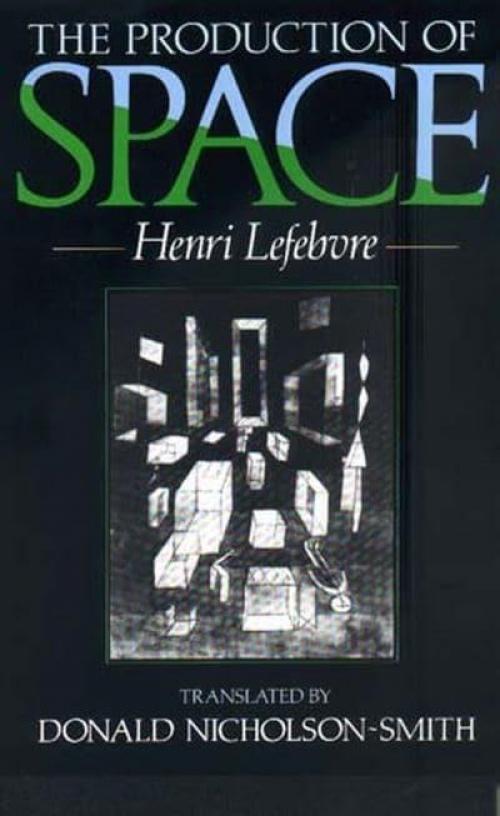
His book “The production of space” was written in 1974 in French, and translated into English in April 1992 by Donald Nicholson-Smith. The book, looks to bridge the gap between theory and practice. He does so by traversing through the fields of literature, art, architecture and economics. Lefebvre looks at space and its production through a three-part dialectic between practice and perception. Henri Lefebvre discusses on the concept of space, through several examples and ideas, and the role of space in shaping society and culture. The book attempts to validate the idea that space is a social product, and that space is shaped by human interactions and social relations. He emphasizes the need to understand the social production of space in order to understand the dynamics of society and culture.
Henri Lefebvre begins his discourse with the history of space, the usage of the term, and its relationship between theory and reality. He argues that descriptions and cross sections of space are just inventories of what exists in the space, but as such cannot give rise to the knowledge of space. Codes may not only be used to decipher (or read) a space, but possibly construct it. His concerns are with the fields of the physical (or natural), the mental (logical and formal abstractions) and the social (i.e. the logico-epistemological [1] space or the space of social practice).
Lefebvre established a conceptual triad, i.e. Spatial Practice (directly experienced or perceived), Representation of space (space conceived) and Representational Spaces (lived through association of images and symbols) [2]. Spatial practice is lived before it is conceptualized. The perceived-conceived-lived model loses its force if treated as an abstract model. Representations of space are abstract, though their intervention occurs though construction (through architecture, not as a building, but as a project embedded in a spatial context). Representational spaces do not need to obey rules of consistency, and as such products of representational spaces are symbolic [3]. Representational spaces are determined as the foci of a vicinity [4]. Spatial practice, representations of space and representational spaces contribute in different ways to the production of space according to their qualities and attributes, society, mode of production and historical period. The relations of production play a part in the productive process of space.
Lefebvre shows how space is all about power. Power relations are implicitly spatial and are constituted by a combination of material, ideal, and every day-social interaction. With capitalism, space appears devoid of social relationships, becoming a plane upon which people interact and events take place. Space is a site of power, and Lefebvre’s work explores the ways in which power operates within and through space
One should read “The Production of Space” by Henri Lefebvre because it offers a profound analysis of the political role that an understanding of space plays in shaping and relating to the places we inhabit. The book’s interdisciplinary approach provides the reader with a new perspective on our world, and its relevance extends beyond philosophy to other academic fields such as urban planning and architecture. The book is not an easy read, and it requires a deep understanding of Lefebvre’s ideas and their significance in the context of various academic fields. However, Understanding the production of space from Lefebvre’s perspective is critical for making complete sense of space, and the book is still an enlightening and essential read today.
[1] a school of thought that deals with the development of theories on the acquisition and justification of knowledge
[2] Spatial practice relates to our everyday routines, social interactions and conventions that shape and transform social space. Representations of Space refer to ways space is represented and perceived (includes language, symbols and cultural practices. Representational space is space that is represented by maps, diagrams and is designed and planned by architects, planners and other experts.
[3] Ch 1 XVII, Pg 43 representation of space is attested to by the plans of their temples and palaces, while their representational space appears in their art works, writing systems, fabrics and so on.
[4] Ch1 XVII Pg 45 The village church, graveyard, hall and fields or the square and the belfry
 Daniel Neville D'Souza