
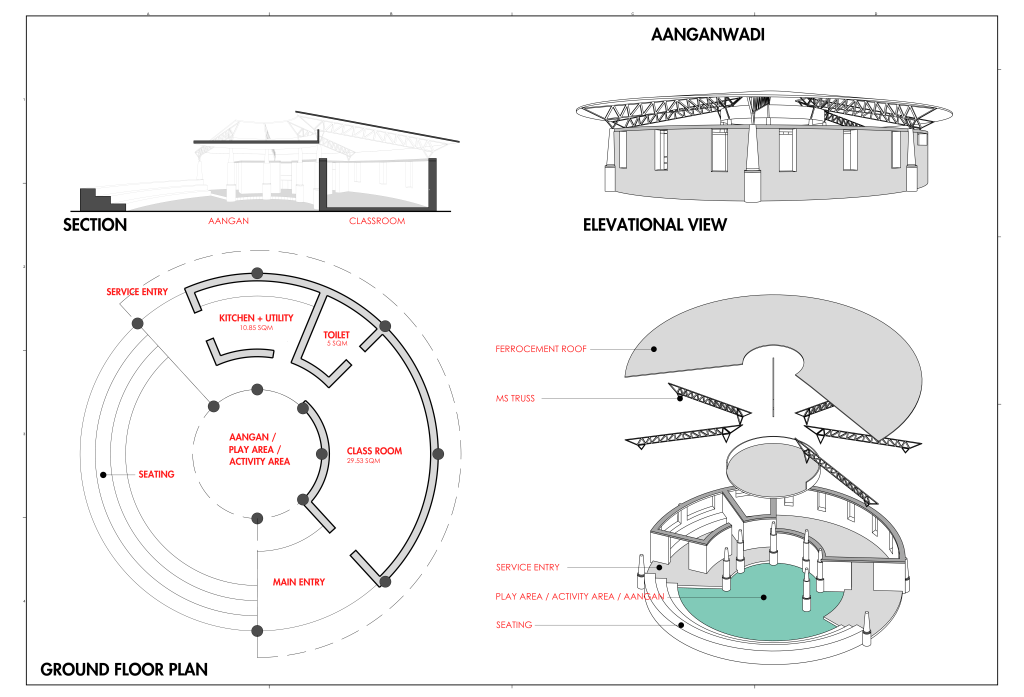
This proposal was for rural educational facilities and was conducted by the Indian Institute of Architects (IIA). The proposal included three scales of schools, including an “anganwadi,” standalone classrooms, and a primary school with three classrooms. The design of the “anganwadi” focused on creating an enclosed, safe space for children to learn in, with a central courtyard that could be used as a gathering and meeting space for the community. The “anganwadi” also had an attached kitchen and utility space for providing mid-day meals to the children. The structure was circular in shape and used locally available stone or brick for the walls, with a metal framing for the roof and ferrocement roof.
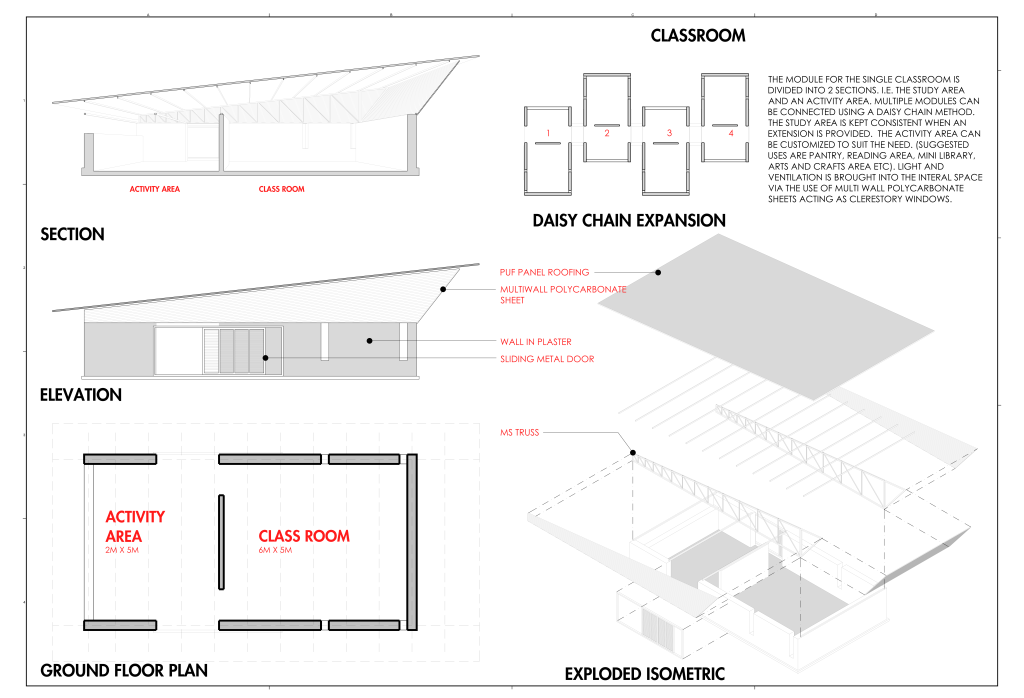
The standalone classrooms were designed as modular units that could be daisy-chained to create a larger set of classrooms. The structure was a simple 5m x 10m grid, divided into two zones, one of which could be used as an activity space and the other as the main study area. The activity space was left open-ended to allow for a variety of programs to be incorporated as the number of classrooms increased.
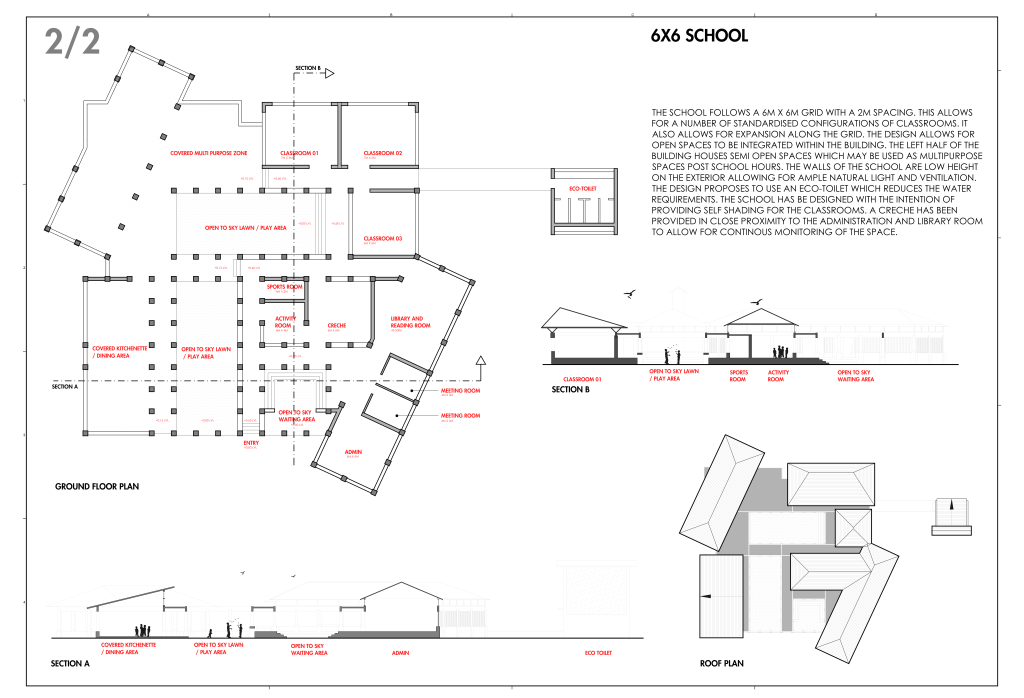
The primary school with three classrooms incorporated a library and reading room, a creche, a covered multipurpose area for functions and activities, and two open-to-sky courtyards. It also had a separate eco toilet. The style and appearance of the structure could be adapted to suit the local style.

 Daniel Neville D'Souza